
Bathrooms, Kitchens & Wet Areas — Complete Specification & Installation Guide, With Notes on Pool Applications
Cluster TOFU Guide — Tile & Stone Adhesive Systems (2026) — Featuring MARMOFLEX-W (C2TES2)
Quick Answer
The best water-resistant tile adhesive for bathrooms, kitchens, and other high-moisture wet areas is a polymer-modified, cement-based adhesive rated C2TES2 under EN 12004 — combining high bond strength, anti-sag grab, extended open time, and high flexibility (S2). For swimming pools and continuously submerged applications specifically, confirm current suitability directly with the manufacturer: the published MARMOFLEX-W TDS covers bathrooms, kitchens, and exterior facades, but does not reference pools or continuous submersion.
1. Why Wet Areas Require a Specialized Water-Resistant Tile Adhesive
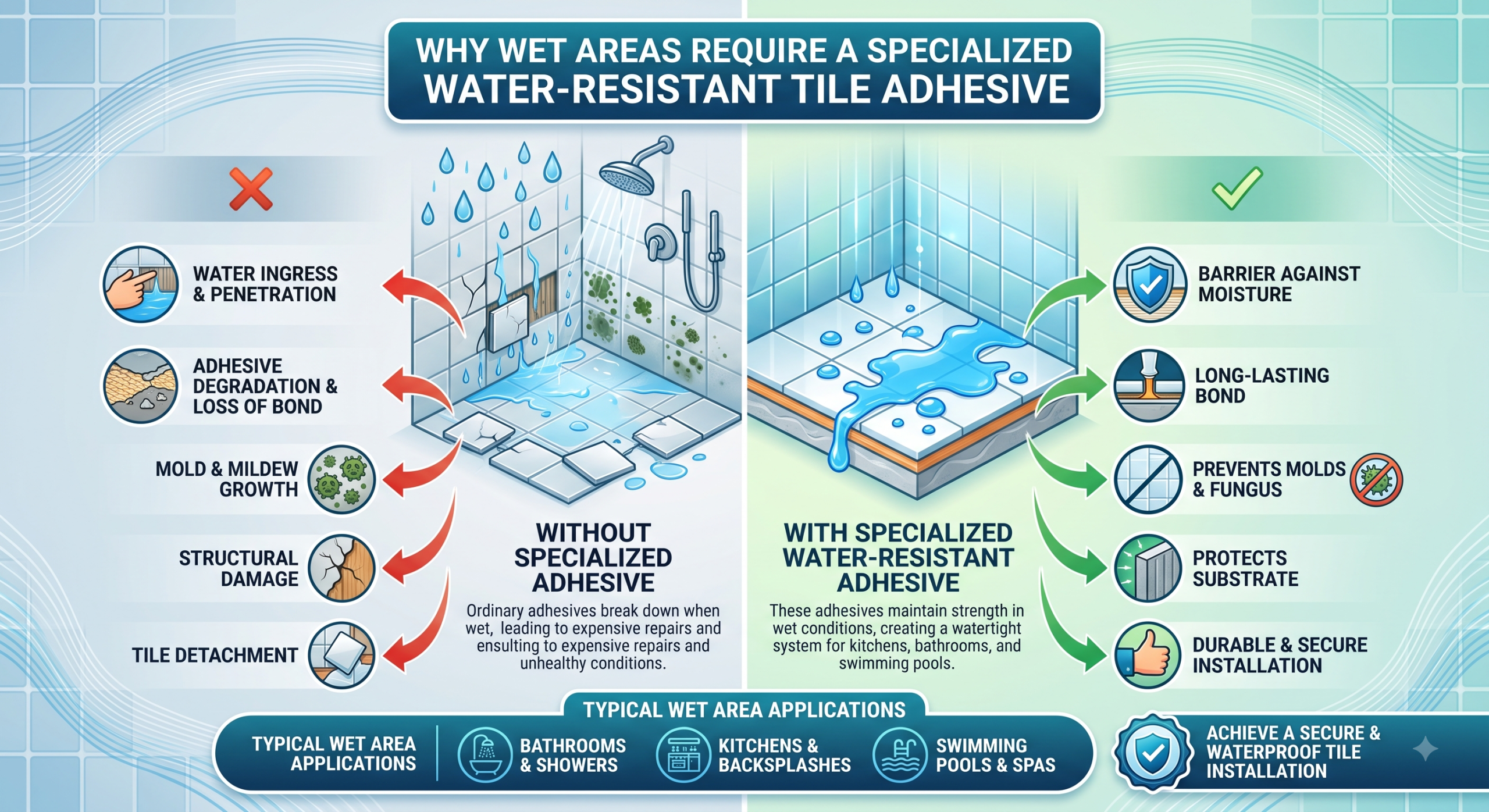
Water ingress is the single primary cause of tile installation failure in wet environments. Whether it’s daily steam in a residential bathroom, frequent washdowns in a modern kitchen, or continuous hydrostatic pressure in a swimming pool, standard mortars and basic adhesives quickly break down when exposed to moisture.
Selecting a specialized, high-performance water-resistant tile adhesive creates a resilient barrier that prevents tile debonding, efflorescence, hollow spots, and water seepage into subfloors.
Hydrostatic Pressure & Chemical Threat
Submerged structures like swimming pools experience constant water weight pushing against the tile bed. Standard adhesives leach calcium and disintegrate under prolonged submersion and chlorinated water treatment.
Efflorescence & Cyclic Stress
Water passing through non-waterproof mortar dissolves free lime, creating white salty deposits (efflorescence). Cyclic wetting and drying also creates lateral shear stress that snaps rigid mortar beds.
For the fundamentals of adhesive classification referenced throughout this guide, see our companion resource: Types of Tile Adhesive Explained (C1, C2, S1, S2 Classification).
2. Product Spotlight: MARMOFLEX-W
MARMOFLEX-W is a premium, two-component, cement-based, polymer-modified adhesive from Marmo Solutions, formulated for wet rooms and heavy moisture exposure, with water and heat resistance confirmed for bathrooms, kitchens, and exterior facades per its official TDS. Full mixing ratios and performance benchmarks are available in the official MARMOFLEX-W technical data sheet.
MARMOFLEX-W Technical Characteristics (per official TDS)
- Classification: C2TES2 (EN 12004), T4S2 (IS 15477:2019), ANSI A118.15 — improved tensile strength, deformable, extended open time
- Tensile Adhesion: Dry ≥ 1.5 N/mm², Wet ≥ 1.0 N/mm²
- Deformability: ≥ 5.0 mm, up to 10 mm (S2 class)
- Open Time / Adjustability: ≥ 30 minutes each; Pot Life 4–5 hours at 25°C
- Slip Resistance: ≤ 0.5 mm — suitable for vertical, non-sag applications
- Color: Grey or white — white formulation ideal for glass mosaics, translucent marble, light porcelain, and pool tiles without color bleeding
- Packaging: 20 kg powder + 5 kg liquid kit; mixing ratio approx. 4.5–5 litres of liquid component per 20 kg bag
3. Application Breakdown by Wet Zone
| Wet Zone Target | Key Structural Risks | MARMOFLEX-W Engineered Solution |
| Bathrooms & Wet Rooms | Water penetrating grout lines and seeping into plaster wallboards or sunken floor slabs | Acts as a dedicated bathroom tile adhesive, forming an impermeable, flexible bond behind ceramic, vitrified, or natural stone tiles |
| Kitchen Backsplashes | Moisture and steam absorption causing mold growth and tile debonding around sinks | Delivers high chemical resistance, zero-slump wall grab for large backsplash tiles, and thermal shock resistance against cooking heat |
4. Technical Performance Comparison
| Technical Feature | Standard Cement Mortar | Basic Tile Adhesive (C1) | MARMOFLEX-W (C2TES2) |
| Water & Moisture Resistance | Unsuitable (dissolves) | Poor (indoor dry only) | High water/heat resistance per TDS (bathrooms, kitchens, facades); continuous pool submersion not TDS-confirmed |
| Tensile Bond Strength | < 0.2 N/mm² | ≥ 0.5 N/mm² | ≥ 1.5 N/mm² dry / ≥ 1.0 N/mm² wet |
| Deformability / Flex Rating | Rigid (0 mm flex) | Minimal (< 1 mm) | S2 Class — ≥ 5.0 mm, up to 10 mm |
| Anti-Sag (Wall Vertical Slip) | High slip | Moderate | ≤ 0.5 mm (per TDS slip resistance spec) |
| Efflorescence Resistance | None (high efflorescence) | Low | High resistance (polymer-locked matrix) |
5. Official Technical Data Sheet Specifications
The table below reflects the manufacturer’s published specifications and supersedes any conflicting figures elsewhere in this guide.
| Spec (per official TDS) | Value |
| Classification | C2TES2 (EN 12004), T4S2 (IS 15477:2019), ANSI A118.15 |
| Component Type | Cement-based, two-component, polymer-modified |
| Color | Grey or white |
| Packaging | 20 kg powder + 5 kg liquid kit |
| Mixing Ratio | Approx. 4.5–5 litres of component B liquid per 20 kg bag |
| Open Time | ≥ 30 minutes |
| Pot Life | 4–5 hours at 25°C |
| Adjustability Time | ≥ 30 minutes |
| Application Temperature | +5°C to +35°C |
| Slip Resistance | ≤ 0.5 mm |
| Tensile Adhesion | Dry ≥ 1.5 N/mm² · Wet ≥ 1.0 N/mm² |
| Shear Adhesion | Dry ≥ 1.5 N/mm² · Heat Ageing ≥ 1.0 N/mm² · Wet ≥ 1.0 N/mm² |
| Deformability | ≥ 5.0 mm, up to 10 mm |
| Coverage | 1.3 kg/m² per mm thickness (approx. 4–6 kg/m² depending on tile size and substrate) |
| Shelf Life | 12 months in original, unopened packaging, stored under 25°C in dry conditions |
6. Step-by-Step Installation Protocol for Submerged & Wet Areas
1. Substrate Preparation
The concrete shell, plaster, or screed must be clean, dry, and cured — concrete shells require a minimum 28-day cure. Ensure the substrate is structurally sound and free from dust, grease, or loose material.
2. Primary Waterproofing Membrane
Apply a primary liquid-applied elastomeric waterproofing slurry over the substrate before tiling. A tile adhesive — however water-resistant — is not a substitute for this membrane.
3. Mixing MARMOFLEX-W
Add approximately 4.5–5 litres of the liquid component per 20 kg bag and mix with a mechanical mixer to a smooth, homogeneous consistency. Allow the mixture to rest (slake) for 5 minutes, then re-stir before use.
4. Directional Trowelling & Double-Buttering
Apply a notched bed to the substrate in parallel straight lines — never a swirling pattern — plus a thin skim coat to the tile back. Press tiles firmly to fully collapse air channels.
5. Curing Time (Grouting)
Allow 24 hours of cure time before grouting, per the TDS.
7. Essential Jobsite Do’s and Don’ts
Do’s
- Apply a primary waterproofing slurry/membrane before tiling wet zones
- Double-butter the back of all pool mosaics and wet-room tiles
- Trowel adhesive in straight parallel lines, not swirls
- Mix only with the supplied liquid component — do not add water
- Use back-buttering for large-format tiles and heavy natural stone
- Refer to the official MARMOFLEX-W TDS for exact mixing ratios and cure schedules
Don’ts
- Do not use standard cement mortar for swimming pool tiling
- Do not leave air voids under pool tiles — they trap water and harbor algae
- Do not fill swimming pools immediately after grouting
- Do not mix adhesive with dirty water, additives, or re-whip setting mortar
- Do not tile over live water leaks or uncured concrete structures
- Do not apply adhesive beyond its open time, or store opened bags for later use
- Do not assume pool-submersion suitability beyond what the official TDS states — confirm directly with Marmo Solutions for pool projects

Frequently Asked Questions
What is a water-resistant tile adhesive?
A water-resistant tile adhesive is a polymer-modified cementitious mortar engineered with synthetic resins that resist water penetration and chemical degradation, maintaining high tensile bond strength in consistently damp or wet environments.
Is standard tile adhesive suitable for bathrooms?
No. Standard adhesives lack the polymer density and water resistance high-moisture zones need. A specialized adhesive like MARMOFLEX-W prevents moisture ingress, debonding, and efflorescence.
Why can’t standard mortar be used for swimming pool tiles?
Standard mortar lacks water resistance and flexibility. Under continuous water pressure and chlorine exposure, raw cement dissolves, causing pool tiles to loosen and pop off.
Is MARMOFLEX-W suitable for swimming pool tiles?
Its TDS confirms high tensile bond strength (dry ≥ 1.5 N/mm², wet ≥ 1.0 N/mm²), slip resistance ≤ 0.5 mm, S2 deformability up to 10 mm, and water/heat resistance for wet areas. However, the published TDS does not explicitly address continuous pool submersion — confirm current pool suitability directly with Marmo Solutions before specifying it for a pool project.
Where can I find the official technical datasheet for MARMOFLEX-W?
The complete technical data sheet, including mixing ratios and physical performance benchmarks, is available as a downloadable PDF from Marmo Solutions.
Is a water-resistant tile adhesive a replacement for a waterproofing membrane?
No. Even a high-performance water-resistant adhesive creates a resilient bonding bed at the tile contact layer only — it should always be paired with a primary waterproofing membrane applied to the substrate, especially in pool and continuously wet environments.
How do I achieve full adhesive coverage under swimming pool tiles?
Use the double-buttering technique: apply a notched bed to the subfloor and a thin skim coat to the back of the tile, combing in parallel straight lines and pressing firmly to collapse air ridges.
Why is white tile adhesive recommended for pool mosaics?
White adhesives like MARMOFLEX-W prevent dark shadows from showing through translucent glass or light porcelain mosaics, keeping tile color consistent.
Can MARMOFLEX-W be used on kitchen splashbacks exposed to steam?
Yes — its non-sag capability and moisture and heat resistance suit kitchen backsplashes and wet prep zones.
What does the S2 rating mean for this adhesive?
S2 designates high deformability — per the TDS, MARMOFLEX-W flexes ≥ 5.0 mm up to 10 mm, absorbing structural movement and thermal expansion without cracking.
How long does MARMOFLEX-W take to cure in a bathroom before water exposure?
Allow 24 hours of cure time before grouting; wait longer before full water exposure. Confirm exact timing on the TDS for your site conditions.
How long must I wait before filling a swimming pool after tiling?
General industry practice for adhesives in this performance class is typically 14–21 days of full cure before filling, adjusted for ambient conditions. This is industry guidance, not a figure stated in the official MARMOFLEX-W TDS — confirm the exact timeline directly with Marmo Solutions before scheduling.
Can MARMOFLEX-W withstand chlorinated and saltwater pools?
The published TDS does not specifically address chlorinated or saltwater pool exposure; its confirmed rating covers general water and heat resistance for wet areas. For chlorinated or saltwater pool environments specifically, confirm current suitability with Marmo Solutions before specifying.
What trowel size is recommended for swimming pool tiles?
An 8 mm or 10 mm square-notched trowel is typical for pool walls and floors, aiming for a finished bed thickness in line with the adhesive’s coverage rate.
Does a water-resistant tile adhesive prevent efflorescence?
High-polymer adhesives like MARMOFLEX-W are formulated to lock free lime inside the matrix, reducing white salt deposits migrating through grout joints when combined with proper curing practice.
Can MARMOFLEX-W be used for tile-over-tile in wet areas?
Its high polymer content supports adhesion over existing sound tiles, provided the surface is cleaned, degreased, and mechanically abraded or primed first.
What is the open time of MARMOFLEX-W?
Per the official TDS, open time is ≥ 30 minutes, with an adjustability time of ≥ 30 minutes at standard conditions.
Why avoid swirling patterns when spreading adhesive in wet areas?
Swirling trowel patterns trap circular air pockets beneath the tile. In wet areas and pools, water collects in these voids, causing pop-offs and harboring algae — always trowel in parallel straight lines.
Is MARMOFLEX-W suitable for steam rooms and saunas?
Its flexible polymer matrix is designed to perform under continuous steam and thermal cycling; confirm the maximum service temperature against the current TDS.
What is the shelf life of MARMOFLEX-W?
12 months from manufacture, when stored in a cool, dry place under 25°C in original, unopened, sealed packaging.
8. Conclusion & Key Takeaways
Installing tiles in bathrooms, kitchens, and other high-moisture areas leaves no room for error. Specifying an engineered, high-performance water-resistant adhesive like MARMOFLEX-W — correctly classified as C2TES2 with dry/wet tensile strength, S2 flexibility, and anti-sag performance confirmed on its official TDS — helps ensure long-term bond strength and resistance to consistent water exposure. For swimming pool and continuous-submersion projects specifically, confirm current suitability directly with Marmo Solutions, since the published TDS does not explicitly cover pool or submerged applications.
Next steps: Download the official MARMOFLEX-W technical data sheet for complete mixing ratios and application guidelines, or continue to our pillar resource, Tile & Stone Adhesive Systems: The Complete Guide (2026). For adhesive classification basics, see Types of Tile Adhesive Explained; for natural stone projects, see Best Adhesive for Marble & Natural Stone Installation


